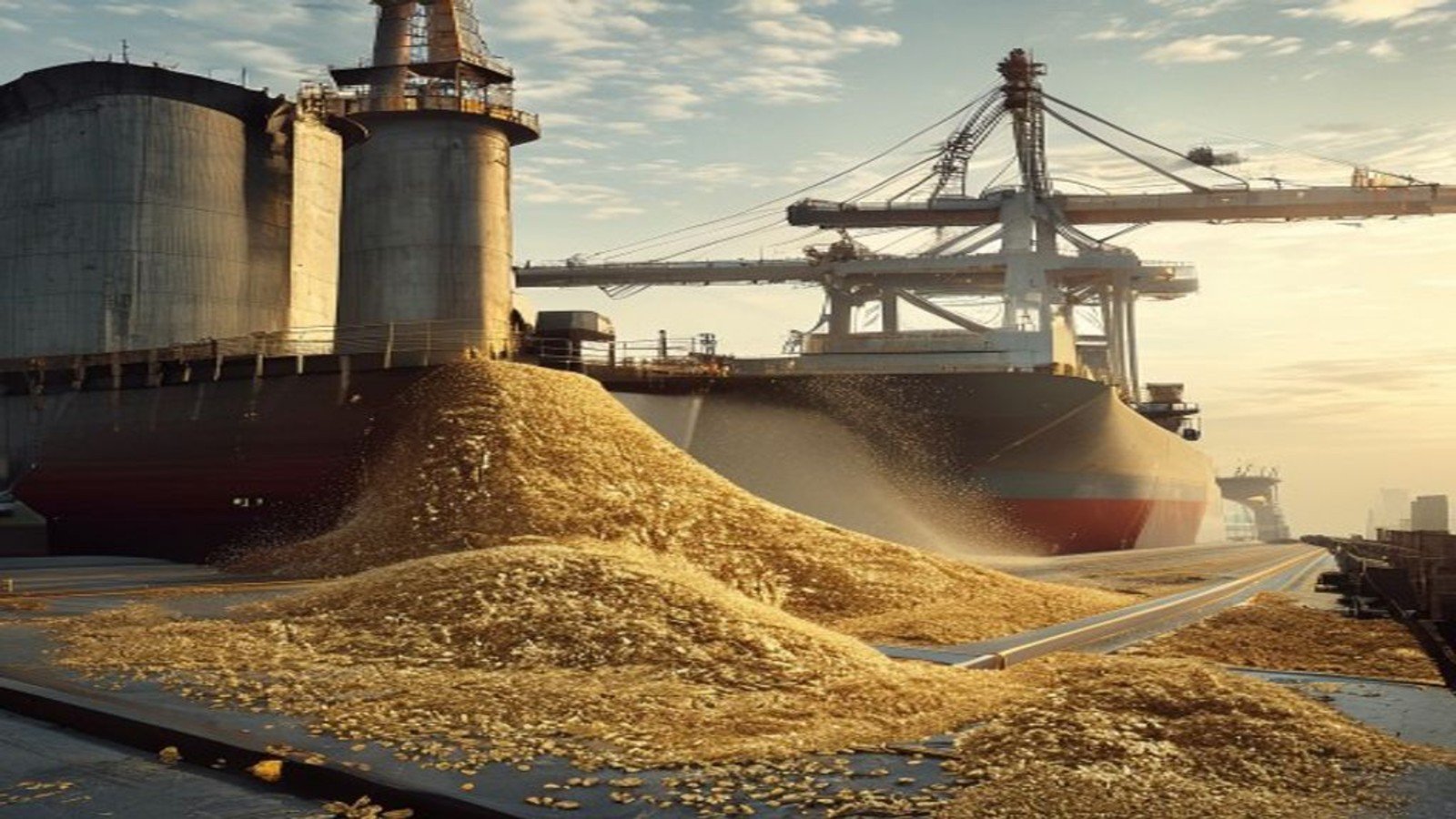
Global food security rests on a surprisingly narrow foundation. A small group of countries produces most of the world’s exportable grain, that grain moves through a handful of maritime chokepoints, and the yields behind it depend on a fertilizer industry concentrated in even fewer hands. When any link strains, the effect propagates within months to bread prices in importing countries thousands of miles away.
Concentration at the source
Wheat, maize, rice and soybeans dominate globally traded calories. Exports are concentrated: a limited set of producers in North America, South America, the Black Sea region, Australia and parts of Europe supply the bulk of what crosses borders. Because production is geographically clustered, a drought in one growing region can remove a meaningful share of world supply in a single season. Production and trade estimates are published monthly by the UN Food and Agriculture Organization.
Read more
NATO Article 5: What Collective Defense Really Requires
Importers are far more numerous than exporters, and many are low-income countries where cereals make up a large share of household spending. That asymmetry is why price spikes translate into political instability faster in some places than others.
Chokepoints on the water
Roughly a quarter of internationally traded food passes through a small number of maritime and inland chokepoints: the Turkish Straits, the Suez Canal, the Panama Canal, the Strait of Malacca, the Strait of Hormuz and the Mississippi River system. Each is vulnerable to a different mix of risks. Canals face drought and draft restrictions. Straits face conflict and piracy. Rivers face low water and lock failures.
Because these points are shared by energy and manufactured goods, a disruption rarely stays confined to food. Freight rates rise across categories, insurers reprice routes, and vessels reroute at additional cost that ends up embedded in landed prices.
Read more
The Nile Dam Dispute: How Water Reshaped Regional Power
Fertilizer is the hidden input
Modern yields depend on synthetic nitrogen, phosphate and potash. Nitrogen production is energy-intensive, made largely from natural gas, so fertilizer prices track gas prices closely. Potash and phosphate reserves are geographically concentrated in a handful of countries. When fertilizer becomes expensive or unavailable, farmers apply less, and the yield consequence appears one or two harvests later rather than immediately.
That lag is what makes fertilizer shocks dangerous. By the time reduced application shows up in output statistics, the decision that caused it is a year in the past and cannot be reversed.
Stocks, speculation and export bans
Buffer stocks smooth ordinary volatility, but stock levels and their distribution matter more than the global total. Much of the world’s grain reserve sits in a few countries that do not release it to international markets. Price discovery happens on futures exchanges, where financial participants add liquidity but can amplify momentum during panics.
Read more
CRISPR Gene Editing Explained: What It Can and Cannot Do
The most damaging policy response is also the most common: when domestic prices rise, exporting governments restrict shipments to protect their own consumers. Each individual ban looks rational and the aggregate effect is to raise world prices further and trigger more bans. Analysis of these cascade dynamics is maintained by the International Food Policy Research Institute.
Climate pressure on yields
Longer-run risk comes from warming. Heat stress during flowering, shifting rainfall patterns, more frequent extreme events and expanding pest ranges all press on yields, while carbon dioxide fertilization offers a partially offsetting effect for some crops. The concerning scenario is not a gradual decline but correlated failure: simultaneous poor harvests in multiple major exporting regions, which historically has been the trigger for the sharpest price episodes. Regional climate projections relevant to agriculture are compiled by the World Meteorological Organization.
What resilience looks like
Practical mitigation is unglamorous. Diversifying import sources reduces single-supplier exposure. Regional grain reserves shorten emergency response time. Investment in crop breeding for heat and drought tolerance raises the floor on bad years. Reducing post-harvest loss, which remains large in many countries, effectively adds supply without adding farmland. And transparent data on stocks and trade flows dampens the rumor-driven component of price spikes.
None of it removes exposure. A system that feeds eight billion people through a small number of exporters and waterways will remain sensitive to shocks. The realistic goal is to make those shocks survivable rather than catastrophic.