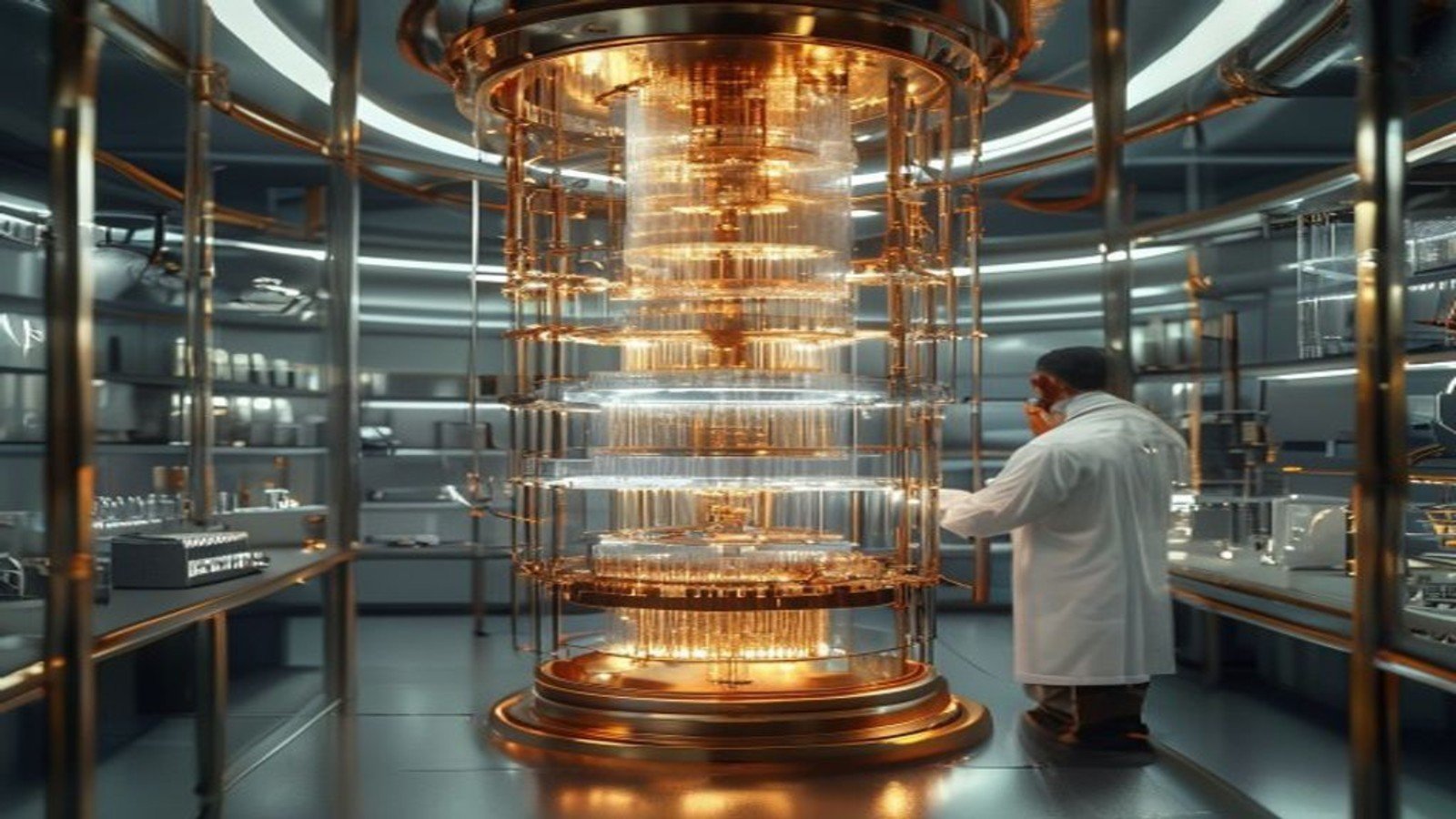
Quantum computing occupies an unusual position in technology discourse: simultaneously over-hyped in near-term expectation and under-appreciated in long-term significance. Sorting the two requires understanding what the machines currently do, what limits them, and which problems have genuine quantum advantage.
Superposition and entanglement, briefly
A classical bit is zero or one. A qubit occupies a superposition described by amplitudes, and a register of n qubits is characterized by two-to-the-n amplitudes evolving together. Entanglement creates correlations between qubits that have no classical analogue.
Read more
How Large Language Models Actually Work
The common claim that a quantum computer tries all answers at once is misleading. Measurement collapses the state to a single outcome, so useful algorithms must arrange interference so that wrong answers cancel and right ones reinforce. Designing that interference is why quantum algorithms are hard to invent, and why so few exist. Accessible technical background is published by the U.S. National Quantum Initiative.
Hardware approaches
Several platforms are being pursued in parallel. Superconducting circuits operate at millikelvin temperatures with fast gate times. Trapped ions offer high fidelity and all-to-all connectivity with slower operations. Neutral atom arrays scale well geometrically. Photonic systems avoid cryogenics for some components. Spin qubits in silicon aim to leverage existing semiconductor fabrication.
None has clearly won. Each faces a different combination of gate fidelity, coherence time, connectivity and manufacturing scalability, and the eventual architecture may combine approaches.
Read more
Data Centers and the Electricity Problem Behind the AI Boom
Error correction is the real problem
Qubits decohere. Gate operations are imperfect. Current physical error rates per operation are far too high to run long algorithms, which is why headline qubit counts are poor progress indicators.
The solution is quantum error correction, in which many physical qubits encode one logical qubit whose errors are detected and corrected continuously. Overheads are large, with estimates commonly running from hundreds to thousands of physical qubits per logical qubit depending on code and error rate. Recent demonstrations have shown logical error rates falling as code distance increases, a threshold behavior that is the key technical milestone. Peer-reviewed results in this area appear in journals indexed through Nature’s quantum information collection.
Which problems benefit
Provable or strongly expected speedups are narrower than marketing suggests. Shor’s algorithm factors integers and computes discrete logarithms exponentially faster, threatening current public-key cryptography. Quantum simulation of quantum systems, meaning molecular electronic structure and certain materials problems, is the most compelling scientific application. Grover’s algorithm gives a quadratic speedup for unstructured search, useful but often insufficient to overcome hardware overhead.
Read more
Antibiotic Resistance: How Bacteria Outrun Our Best Drugs
Claims of quantum advantage in general optimization and machine learning are much weaker. Many proposed heuristics lack proven speedups, and classical algorithms have repeatedly improved to match published quantum results.
The cryptography timeline
A machine capable of breaking widely deployed public-key cryptography does not exist and is not close, but the risk is not purely future. Data encrypted today and captured today can be decrypted later, which is why migration is already underway. Standards bodies have selected post-quantum algorithms based on lattice and hash-based constructions, and migration guidance for organizations is published by the NIST Post-Quantum Cryptography project.
Symmetric encryption and hashing are far less affected, requiring only larger key sizes. The urgent work is inventorying where public-key cryptography is embedded, which in most large organizations turns out to be almost everywhere.
How to read announcements
Three questions separate substance from noise. What is the two-qubit gate error rate, since that determines circuit depth. Are the reported qubits physical or logical. And is the demonstrated task one where the best classical algorithm has actually been tried, since several claimed advantages have been overturned by improved classical simulation.
Applied to most press releases, those questions resolve the picture quickly. The field is making real, measurable progress on error correction, and commercially decisive applications remain some years out.